We came to Katowice mainly as a transfer stop on the way somewhere else. But the city centre personally stopped me in my tracks – in a good way. I expected a grey industrial city and got a lively centre that breathes at first glance, and when I saw old photos it was clear that, year by year, it’s building its reputation as the capital of Polish Silesia. Katowice is one of Poland’s relatively young cities, and maybe that’s exactly why it feels more self-confident than many a historic metropolis – say, Přerov (with a wink). Let’s take a look at all 12 things to see and visit in Katowice.
Why Katowice Will Surprise You
What to see in Katowice – you may have asked yourself that when planning a route through southern Poland, and the answer is: far more than you’d expect from a former mining town. Katowice is no open-air museum. It’s a city that doesn’t hide its industrial past but instead builds its identity from it (just like Ostrava now).
The old mines and shafts live on here as museums, concert halls and viewing towers. The mix of brick miners’ colonies, socialist brutalist architecture and a modern cultural zone makes Katowice one of the most interesting cities I’ve seen in Poland so far (until then it had been 2 other cities).
The 12 Things to See in Katowice
Nikiszowiec
Definitely make the trip here. Nikiszowiec is a former mining colony from the early 20th century, a kind of oasis built for miners and their families. Rows of red-brick apartment houses that strikingly reminded us of the Baťa houses in Zlín. The district is remarkably well preserved; in 2011 it was added to the list of national cultural monuments and National Geographic ranked it among the seven wonders of Poland.
It’s about 20 minutes by car from the centre and you can park almost anywhere here without trouble.

Giszowiec
Not far from Nikiszowiec you’ll find Giszowiec, another mining district but with a completely different character. While Nikiszowiec is dense block development, Giszowiec feels more like an English garden village with family houses. Both districts were created for the same reason – to provide dignified housing for miners. It’s worth walking through both to see how differently the idea could be approached.
Spodek Arena
Spodek, literally a “saucer”, is a Katowice icon from 1971 and one of the best-known examples of brutalism in Poland. Its shape really does resemble a landed UFO and it still hosts concerts and sporting events. Even when nothing’s going on inside, the façade alone is worth a photo.

Silesian Museum
The Muzeum Śląskie is unique in that its main exhibitions are located underground, in former mine tunnels. Some exhibitions are still being completed, but the visit is rich even so. On Tuesdays entry to the whole museum is completely free; otherwise expect standard admission of up to 20 PLN.

Warszawa II Shaft Tower
Part of the museum grounds is a viewing tower on the former Warszawa II shaft. A lift takes you up for about 7 PLN and the view of the city and the Cultural Zone is worth it. But watch out! In strong wind or bad weather the lift to the top doesn’t run, so leave some slack in your plan and keep an eye on the weather. It was blowing like crazy for us, so we saw diddly-squat.

Superjednotka
If you love brutalism as much as I do, then this spot can’t be missing from your list of things to see in Katowice. A bit further on stands Superjednotka, a giant socialist apartment block from the 1970s with 762 flats and internal “streets” on every floor. It’s exactly the kind of architecture you either love or that makes you want to throw up a little. Either way, it’s worth stopping for.
We walked around it and gawped with our mouths open. In České Budějovice we have a similar building, once called Koldům, today Perla. It’s one of the first prefab panel buildings in the Czech Republic. Our whole city is definitely worth a visit if you’re into this kind of architecture.
Silesian Insurgents’ Monument
The monument, shaped like three eagle’s wings, commemorates the three Silesian Uprisings of 1919 to 1921. It stands in Park Powstańców Śląskich and is one of the most striking symbols of Katowice’s modern history.

Park Kościuszki
This sprawling 72-hectare park offers a quiet walk just a short way from the busy centre and is ideal as a rest stop in the middle of a day full of walking.
Park Silesia
Another of Katowice’s green spaces where you can escape when the industrial architecture starts to feel a bit much. A great place for a picnic or an afternoon stroll.
Valley of Three Ponds (Dolina Trzech Stawów)
A body of water surrounded by greenery, cycle paths and walking trails – a popular local spot for running, cycling and birdwatching.
Church of the Immaculate Conception of the Blessed Virgin Mary
This neo-Gothic church, nicknamed Mariacki by locals, is the oldest surviving Catholic church in central Katowice. Stop in to see the altar and the stained-glass windows. Even a few minutes inside are enough to soak up a pace quite different from the one out on the streets.

Mariacka Street
Mariacka Street is one of the most photogenic corners of the centre and at the same time one of the best places to sit down. A whole row of venues, cafés and restaurants stretches along it. Feel free to get swept up and find your own favourite spot here. You’ll do well. On the other hand, I was surprised how, during the World Cup, there was a real shortage of football buzz here.
Where to Go for Coffee
Just as in other Polish cities, we hunted for coffee here using the European Coffee Trip ranking. We definitely recommend Proper Coffee and Black Woolf Coffee & Books – the latter also combines coffee with a bookshop, so you can mix business with pleasure. The tricky bit is when you don’t speak Polish; at least then you can just enjoy the coffee 🙂
Price-wise, filter coffee in Katowice is very similar to back home, so don’t expect any price shock. Around 15 PLN for a cup of coffee.
How to Get Around the City
You can walk around the centre, but if you want to save time or see more, the shared Metrorower bike is worth it; it operates in dozens of cities across Poland. Prices are pleasantly low – half an hour costs you 1 PLN, a whole hour 2.5 PLN. Generally, such “social and cultural” services are significantly cheaper in Poland than back home, and Metrorower is a nice example of that.
I think exploring from the bike saddle is a great way to get around all the things to see in Katowice.

Practical Information
Where to Stay in the Centre
The best choice is Śródmieście – the centre itself around the Rynek and Dworcowa Street. From here it’s a ten-minute walk to the Silesian Museum, Spodek and Mariacka, so you can do without a car or public transport. A quieter alternative is the Koszutka district, right next to the centre and a stone’s throw from the Cultural Zone – ideal if you want a bit more peace in the evening but don’t want to waste time commuting.
Parking
Paid parking zones apply in the centre on working days from Monday to Saturday, usually 7:00-17:00 (check the exact zone boundaries and exceptions for some Saturdays on site). What I’d use instead of cash is convenient payment via the epark or Anypark apps.
For convenience we parked right in the centre under the Galeria Katowicka shopping centre, from where everything on the list is within reach. Unfortunately only 2 hours were free here, after that 4 PLN, I think.
Airport and Cheap Flights
Katowice has its own international airport, Katowice-Pyrzowice, about 30 kilometres from the centre, with connections from low-cost carriers like Wizz Air and Ryanair to dozens of European destinations. If you live near Katowice (or are planning a trip here), it’s a great option for both departures and arrivals.
Trips in the Area
Katowice sits perfectly as a base for a longer Polish trip:
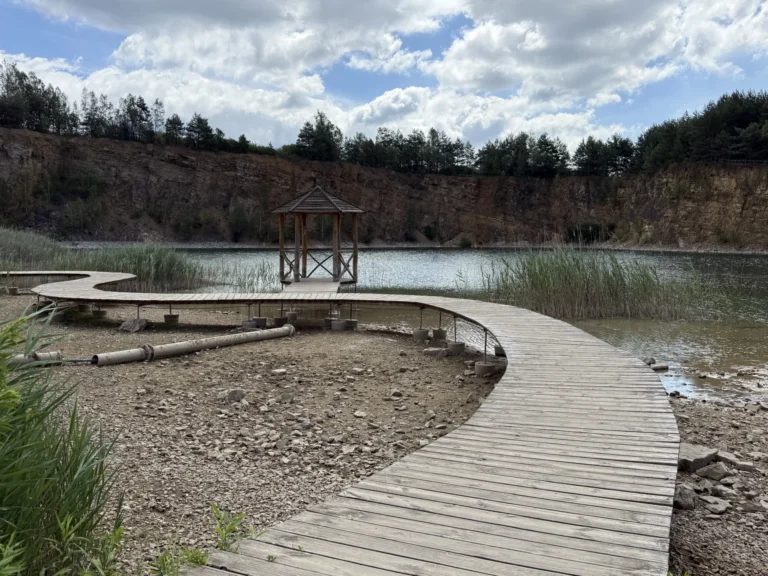
- Gródek – turquoise lakes in a former dolomite quarry near Jaworzno. Also nicknamed the Polish Maldives.
- Auschwitz – just under 35 kilometres from Katowice. It was precisely Upper Silesia’s well-connected railway network that was one of the reasons the Nazis built the Auschwitz-Birkenau concentration camp in this area. The reason was simple – it made transports easier, and the proximity of industrial plants also allowed the forced labour of prisoners to be exploited.
- Kraków-Częstochowa Upland (Polish Jura) – castles like Ogrodzieniec, Mirów or Bobolice on the so-called Trail of the Eagles’ Nests.
- Pszczyna – a Baroque castle with preserved interiors from the turn of the 20th century, surrounded by a vast park.
- The Guido Mine in Zabrze – the deepest coal mine open to visitors in Europe, where you descend up to 320 metres below the surface.
Frequently Asked Questions
Before you set off on a longer journey through southern Poland, take a look at our tips on travel insurance and the best hiking apps if you’re also planning walks outside the city.